Friday, 14 May 2021

Reflections on characters and themes in The Hustler (1961)


Reflections on “The Hustler” (1961)

Directed by Robert Rossen

Screenplay by Sidney Carroll and Robert Rossen

Based on the novel by Walter S. Tevis

Starring Paul Newman, Piper Laurie, George C. Scott and Jackie Gleason

Driven by a desire to prove himself the best, as well as the desire to win a considerable sum in bets, Fast Eddie Felson seeks to take on Minnesota Fats in a marathon pool session, but discovers there is a heavy price to pay in terms of relationships and humanity if he is to make it to the top of his chosen profession as a pool hall hustler.

Eddie learns the hard way there is more to winning than simply having talent. When he loses to Fats in their first pairing, it is pointed out to Eddie that while he has the ability, he lacks the “character” required to make him a winner. That is to say, he lacks the stamina, perseverance and discipline to pace himself in order to play the long game. For this is not akin to a tournament with set limits and clear criteria for success – this involves playing until your opponent is vanquished and admits defeat. Indeed, it might even be argued that the game is merely the means of taking on the character and very essence of your opponent in order to best him or her. It develops into a titanic contest of egos and spirit with talent and skills merely serving as the tools to decide the combat.

Eddie learns another important lesson, that there will always be money men, here in the shape of Bert Gordon, willing to help encourage and direct the careers of those who display sporting talent and ability (or indeed ability in any field of endeavour), for a substantial share of the proceeds. These are businessmen who act with purely mercenary and professional motives. They will take on managerial responsibility for organisation and administration in return for the application of sporting talent. The sportsman or player is an investment and he or she will be expected to toe the line in exchange for their highly lucrative and career-enhancing managerial services.

These money men will also be willing to manipulate situations and the emotions of their investments in order to ensure a greater return. Bert is cold, calculating and confident, but Eddie initially rejects his offer to represent him due to a sense of loyalty to his friend and fellow hustler cum manager, Charlie. However, Eddie and Charlie’s relationship comes to an abrupt end when Eddie’s ego and ambitions get the better of him and he fails to appreciate Charlie’s efforts to protect him from himself.

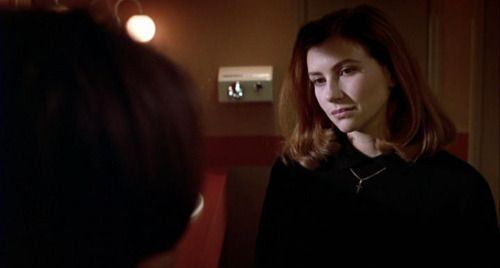
At least in part, Eddie loses his first match with Fats because of his humanity. He displays human weakness and arrogance but also naivety, self-doubt, lack of tenacity and understanding, and pain. As a result of his defeat and his underlying humanity, he turns to a girl he encounters, Sarah Packard. Sarah is a damaged soul who has suffered physical and emotional hardship, and on some intuitive level Eddie may feel she can offer him some much-needed comfort, sympathy and understanding. She is vulnerable but possesses character, and these qualities seem to appeal to the tender side of Eddie’s nature.

Sarah has been a victim and has been let down in life. She struggles to accept reality, or the potential ugliness and pain of reality, and tends to build a falsely positive view of the men in her life. Just as Eddie may have sensed an inherent capacity for sympathy in her, she may detect Eddie’s deep-seated humanity and goodness and this gives her hope for their future together, though at one point she actually chides herself for refusing to recognise Eddie’s failings.

Although it is not all plain sailing, Eddie and Sarah are good for one another and each grows in confidence and stability to the extent that Eddie once again tries some pool hall hustling without the overview of a Charlie or a Bert, and everything goes horribly wrong. Without experienced and astute oversight and guidance, Eddie defeats and humiliates his opponent who, outraged at Eddie’s attempted scam, assaults Eddie with some friends, and they break Eddie’s thumbs.

Sarah takes care of Eddie and is almost protective of him as she tries to foster the humanity she perceives in him and divert him from hustling in pool halls. They even discuss what it means to be a winner and a loser. A loser may be associated with compassion, a weakness according to Bert’s interpretation, while a winner is rather simplistically summed up by Eddie as one who owns things. Interestingly, it is Bert who is held up as a winner in Eddie’s eyes, and not Minnesota Fats. He recognises the power of money and organisation over success in terms of skill and talent, but he resists the notion of joining Bert as he holds on to care and consideration for others under Sarah’s influence.

When Eddie recovers and has his casts removed, Sarah is visibly disappointed and concerned as she realises he will be able to and will wish to exercise his pool and hustling skills once more, drawing him away from her and, perhaps more importantly, away from compassion and understanding toward the hard and harsh world of winning, no matter the cost.

Eddie sees no future without pool and a mentor so he turns to Bert to guide and direct him, though he remains uncommitted to Bert’s cold and ruthless outlook as he insists on bringing Sarah on a road trip to the Kentucky Derby organised by Bert.

Bert becomes increasingly frustrated by Sarah’s influence which is hindering the development of a killer instinct in Eddie, so he manipulates the situation until Eddie is forced to choose between Sarah and taking a significant step toward fulfilling his ambitions by playing a socialite named Findley. Blindingly overwhelmed by his now reinvigorated taste for success, Eddie angrily rejects Sarah when she suggests they leave, and goes on to defeat Findley, winning $12,000 to be split rather unevenly with Bert.

Somewhat dispirited and despondent at losing Eddie and perhaps more generally her battle with nihilism and corruption, Sarah returns to her hotel room where Bert makes a pass at her. His advance is vigorously spurned but, on reflection and in a state of depression, Sarah abandons herself to the cold and harsh reality she has always resisted and accepts Bert’s hospitality, perhaps because she feels she has lost not just Eddie but hope and self-belief as well.

However, she is unable to live with this choice and what she may have judged as her degradation and betrayal of herself, and she commits suicide.

Eddie turns on Bert and shortly afterward he challenges Minnesota Fats to a rematch, using his share of the money he won when he played Findley as his stake. Eddie ruthlessly defeats Fats, applying the cold and professional attitude Bert hoped to instil in him. However, it is a hollow victory as it has come at a great price.

Bert demands his share of Eddie’s winnings and threatens him with violence if he doesn’t pay up, thus revealing his true nature and philosophy in the process. Fats remains conspicuously silent during this face-off. He and Eddie compliment one another as players but he has long since accepted his place in the running of things and he will do nothing to defy or antagonise his cold-hearted financial backer and boss.

Eddie mentions Sarah and reminds Bert of the part each of them played in her fate. This appears to shame Bert, at least enough to allow Eddie to keep all his winnings on this occasion, but he warns Eddie he should not expect to be allowed to continue to play in any big-time pool halls.

Eddie is finished professionally, but perhaps he is willing to accept this punishment, and the emotional damage he has suffered, as a condition of retaining his humanity and his capacity to show compassion and understanding to others. Indeed, he even tells Bert that HE is a loser, suggesting something of a change in his priorities and his view of the world.

Although I found the script a little verbose and laboured in places, it deals well with conflict and the characters are all very well drawn. Atmosphere, tension, emotion and tragedy are all conveyed very clearly and I thought the performances were all admirable and pleasing, especially those of Paul Newman and George C Scott.

On a final note, I must say I was disappointed in the storyline of the sequel which failed to advance or even pursue the course suggested by the story development and the ending of “The Hustler”. Indeed, in the sequel Eddie’s character evolution seems to go in reverse as he is keen to take on an almost Bert-like role in the manipulation of a young and talented newcomer. Perhaps, with time, he succumbed to and adapted to the hard and harsh reality of life.


My thanks for taking the time to read this article. I hope you found it of some value.

Stuart Fernie (stuartfernie@yahoo.co.uk)

HOME

BLOG

Friday, 23 April 2021

Reflections on characters and themes in Road to Perdition (2002)


Reflections on “Road to Perdition”

Directed by Sam Mendes

Written by David Self

(based on the graphic novel by Max Allan Collins and Richard Piers Rayner)

Starring

Tom Hanks, Paul Newman, Daniel Craig, Tyler Hoechlin and Jude Law


A video presentation of this material can be viewed here.

When gangland enforcer Mike Sullivan’s son, Michael, witnesses a murder committed by Connor Rooney, the son of gangland boss John Rooney, who is also Mike’s boss and mentor, this sets in motion a chain of events that lead to the deaths of Sullivan’s innocent wife Annie and his second son, Peter. Sullivan will consequently abandon the code he has always followed and will challenge the mores, social structure and hierarchy he has known all his life as he takes whatever measures are necessary to protect himself and his son from former colleagues and friends while seeking vengeance on the self-indulgent Connor who, desperate to ensure his own safety and survival, is responsible for the deaths of Mike’s wife and child.

The film offers insight into the milieu and politics of Depression-era gangsters while examining father-son relationships and the conflicts and complications they can generate. Underpinning everything is the contrast between John and Connor’s relationship and Mike’s efforts to instil values and respect in his son amid a general contempt for law, order and morality.

There is no recourse or reference to law enforcement or religion. Instead, we have a pragmatic or Machiavellian gangster order in which morality, honour and rectitude are reduced to keeping your word, being discreet and protecting fellow gang members if that serves the greater good.

Connor’s conduct goes beyond self-centred indulgence and borders on narcissism. He exercises emotional manipulation of his all-powerful father which may be due to his apparent inability to impress his father or gain his respect. In turn, Connor’s perceived character weaknesses may be the result of John’s apparent inability to impose discipline on his son and his mollycoddling of him. Of course, it may also be due, in good part, to the environment in which he has been brought up, with no respect for values or consideration for others beyond their use in the advancement of family “business”. At one point, Connor is described as “a big baby” by another powerful gang boss, but he is so consumed by his own character and importance that he fails to recognise any truth in the description and instead offers vague threats based on his future position as the head of the family business, further confirming his delusions and lack of self-awareness as he fails to see that he is tolerated only because of his father and his influence.

John Rooney knows himself and recognises what he is. He is willing to steal, cheat and murder but he is aware of the pain and consequences he can inflict on others in pursuance of his business affairs. He appears to prefer a balanced and restrained approach to business, using violence as a tool and resorting to it only when necessary, and refusing to exploit his clientele at their work as well as in their leisure time.

His great weakness is his devotion to his son, Connor. Intelligent and insightful, John also knows who and what Connor is but he cannot discipline him and is obliged to cover for Connor’s ill-considered actions and indiscretions. Perhaps he is clinging to the only meaningful blood tie left to him as all other relationships can be bought and sold, used and discarded. He is clearly close to Mike Sullivan whom he has brought up as a member of the family but whose life has been dedicated, or even sacrificed, to pursual of Rooney’s nefarious interests as Sullivan was trained to be an enforcer and an assassin. There is a closeness, affection and understanding between them but Rooney requires complete devotion and compliance from Sullivan. Mike is not afforded the same freedom and indulgence as Connor yet Connor is envious of the respect and warmth shared by Rooney and Sullivan. Ultimately, however, Mike is treated like a loyal vassal and he is expected to accept the murders of his wife and son by Connor as part of that loyalty, but their loss proves too much for Mike, whose allegiance has reached its limit.

Mike’s life appears to be governed by loyalty, gratitude and indebtedness, all of which lend a tragic and contradictory aspect to this unsmiling, taciturn, dangerous and profoundly conflicted man.

As a youngster, Mike was taken in by John Rooney who provided him with a home, comfort and security, all of which were appreciated by Mike to such an extent that they fostered within him a profound sense of debt, a reaction that suggests he is a man of honour in spite of his actions and profession. Rooney has continued to provide for Mike, his wife and his family, and gratitude, debt and loyalty are the price Mike feels he must pay for this stability, especially in these difficult Depression-era times.

Often silent and distracted, it seems that his life as an enforcer weighs heavily on Mike. He is aware of the effect he delivers, even dread, when he gives his name. At home, when his son Peter inquires about the nature of his work, there is a sudden change in atmosphere and Mike’s wife snaps that he works to put food on the table. This telling response suggests not just a desire to protect the boys from the truth but also shame or embarrassment and that this is something he does out of necessity rather than through ambition or desire.

These are parents who seek to instil discipline and family values in their children. Mike and his wife could easily have lied about the nature of his work, but they choose not to do so. The boys are expected to show respect, not to question and to do household chores. They are encouraged to do their homework and they have a warm and loving relationship with their mother.

At home, it may be the true man we are seeing, a man of honour and values but one who loyally serves his criminal master by day, undertaking threat, violence and murder in his name, surely leading to internal conflict and depression which explain his silence and distraction. Mike may be trapped in his existential quandary and may be somewhat distant with his sons, but he is determined that his sons should have an outlook and options based on respect for others and a principled upbringing, all in direct contrast to the upbringing experienced by Connor.

Michael represents hope for the future in Mike’s eyes. In the aftermath of the murders of their kin, father and son are united by common grief, experience and a need for one another. They get to know one another better and do what they must to survive, but their efforts are tempered by reason and control. They are pursued by amoral individuals and may use amoral methods to deal with them yet they show constraint and balance. Michael is forced to grow up quickly and he shows calm determination in helping his father. In part reflecting his maturity, his idealistic and romanticised view of his father and his work (symbolised in his interpretation of the graphic novel he is reading) is steadily replaced with respectful realism.

In contrast to Mike’s human and flawed assassin, we have Maguire, a quirky hitman hired to take out Mike and his son. Maguire is an assassin who enjoys his work. He is totally amoral – he has no scruples and indulges his passion for death by photographing the recently dead or dying. Although ostensibly he and Mike have much in common, Maguire does not suffer from self-doubt or inner conflict and he is not acting to fulfil a perceived debt of honour. He kills because it gives him pleasure and fulfilment, and his very presence and motivation allow us to compare and contrast with Mike and enable us to gain a clearer understanding of Mike’s existential position and attitude.

At the end of the film young Michael could have killed Maguire. He holds the upper hand, in the shape of a gun, but he is hesitant and unwilling to shoot, though he might have pulled the trigger if necessary. Fortunately, Mike removes that necessity and takes upon himself the guilt of killing Maguire, thus sparing his son from having to take a life and allowing him to walk away with an unblemished conscience. Mike dies happy in the knowledge Michael did not mindlessly pull the trigger – in a world where morality may not exist in itself and in an environment where it is certainly not respected, the values and self-discipline he has tried to instil in his son have won out over self-centred amorality.

This is a brooding, atmospheric character piece set for the most part in a dark, shadowy world which contrasts with the airy lightness and hope of the scenes at the end of the film. On the face of it, this is a well-constructed revenge thriller offering relatively familiar fare in terms of politics but its great strength lies in the contrasting father-son relationships and how they inform the moral choice at the core of the film.


My thanks for taking the time to read this article. I hope you found it of some value.


Stuart Fernie (stuartfernie@yahoo.co.uk)


HOME


BLOG


Thursday, 25 March 2021

Reflections on characters and themes in "The Verdict" (1982)


Reflections on “The Verdict”

Directed by Sidney Lumet

Screenplay by David Mamet

Starring Paul Newman, Charlotte Rampling, Jack Warden and James Mason


The underpinning context of “The Verdict” and its storyline is a legal system in which personal ambition, status, survival, self-satisfaction and manipulation of technicalities appear to have overwhelmed the system’s fundamental precept of seeking justice. It is also the story of Frank Galvin’s rediscovery of this underlying principle and his fight to gain justice for his client while regaining his own self-respect.

The subject of the legal case in hand is a young woman who attended a Catholic hospital for the birth of her baby. She received an anaesthetic which caused her to vomit and choke while sedated and, deprived of oxygen, she suffered brain injury, became comatose and then dependent on life support equipment.

Virtually all the characters are opportunistic or pragmatic to one degree or another. They accept the conditions and environment in which they work, adapt, and do what they can or need to do in order to make their way in the world, with little or no genuine or prolonged thought for the subject of whatever case they are dealing with.

The victim’s sister and brother-in-law care for the victim but, worn down by time, pressure and grim reality, they are content to settle with the defendants to provide ongoing care for the young woman, but also to ease their own lives.


The Bishop responsible for the administration of the hospital is keen to play down the case for the sake of the smooth running of the hospital but is equally keen to offer only a modest settlement as a pay-off while ignoring the issue of the hospital’s negligence and responsibility, and their consequences for the patient.

The doctors accused of negligence are content to be carefully tutored in their responses to questions so as to deflect awkward queries that might imply responsibility, to avoid any hint of a bad impression and to create confidence and trust.


This tuition or preparation is overseen by Ed Concannon, a celebrated, highly successful and quite unscrupulously determined legal craftsman who points out at one stage that he is paid to win, thereby suggesting a certain lack of moral integrity, replaced by legal dexterity.

Even the Judge in charge of the case appears to regard the proceedings as a game in which pride, self-satisfaction and legal fraternity have won out over principle and the underlying purpose of the proceedings.

These characters may be opportunistic, self-centred and blinkered but it is clear where they stand. The same cannot be said of Laura who ingratiates her way into Galvin’s confidence and affections only to betray him to Concannon for money. This is pragmatism taken to the length of treachery.

When we first meet Frank Galvin, the lawyer engaged to represent our hospitalised victim, he is no better than any of the other characters. Frank has become an ambulance chaser. He is reduced to pursuing legal work by offering his services to the families of recently deceased people involved in accidents. At one time he was something of an idealist and a champion of principle but he was defeated by the cynicism, opportunism and corruption of others. His real crime, however, is that he accepted this defeat and he has steadily descended into disappointment and self-contempt. He now goes through the motions of a career in an attempt to keep his head above water and he drinks excessively because he recognises and disapproves of what he has become but also, perhaps, because he can’t find the strength or the motivation to raise himself out of the pit into which he has dug himself.

Frank’s colleague and loyal friend Mickey helps him by having him undertake what he regards as a straightforward medical malpractice suit which all concerned parties are keen to settle. However, when taking evidential photos for the case, Frank has something of an epiphany as he is made aware of the human consequences and repercussions of the medical error at the heart of the case. This is no longer merely an academic, money-making procedure – Frank’s humanity and sense of purpose are unexpectedly rekindled and he opts to take the case to trial and seek justice rather than accept a sizeable fee in exchange for settling out of court and effectively sweeping the whole affair, and his client’s life, under the carpet.

Naturally, Frank struggles to make his case, especially in the face of various underhand tactics employed by his legal opponent, all designed to ensure courtroom victory while denying, perhaps, natural justice.

Legal thrillers and courtroom dramas frequently end with a revelation that proves a case and apportions blame where it should be, and this film is no exception. Evidence is produced that reveals truth but, in keeping with the themes of opportunism and manipulation at the expense of justice, this evidence is to be dismissed on a legal technicality.

Legally speaking, Frank’s case is over and he is left with nowhere to go in his summation speech except to appeal to the jury for justice.

Dr Thompson, Frank’s expert witness whose position and testimony are belittled, manipulated and derided in court, despite offering an accurate assessment of events, suggests to Frank that he should not underestimate people and their capacity to hear the truth. Possibly with that thought in mind, Frank suggests to the jury in his summation that justice does not exist in itself and that for now, they are the law. As human beings and members of society, we create justice by listening and applying a sense of fairness, and this rather sums up the principal theme of the piece. The law can only aspire to the spirit of justice and upholding the law and its technicalities should not necessarily be regarded as a valid objective in itself, especially if in doing so, natural justice is failed as a result.

This gritty and relatively realistic legal drama manages to deliver the usual courtroom thrills while outdoing many of its rivals in terms of its underpinning issues and philosophy and its appeal to humanity, hope and honour with regard to its character development. Frank’s rediscovery of idealism and integrity is not without difficulty as he gives in to and then battles fear, intimidation and self-doubt, but his slow and steady transformation is complete when he chooses dignity and principle as, drinking mere coffee, he declines to answer the treacherous Laura’s phone call at the end of the film.

The whole was filmed in a natural, almost subdued style which suits the general import and tenor of the film, and Paul Newman has rarely, if ever, been better as he captures Frank’s soulless survival and grifting, and his own surprise at his desire to do the right thing for his client whose case was merely being shunned or exploited by virtually all those involved.


My thanks for taking the time to read this article. I hope you found it of some value.

Stuart Fernie (stuartfernie@yahoo.co.uk)

HOME

BLOG


Saturday, 13 February 2021

Reflections on characters and themes in the Three Colours Trilogy


Reflections on The Three Colours Trilogy

Directed by Krzysztof Kieslowski

Written by Krzysztof Kieslowski and Krzysztof Piesiewicz

Starring Juliette Binoche, Julie Delpy, Zbigniew Zamachowski,

 Irène Jacob and Jean-Louis Trintignant


Foreword

Fundamental to each of these three films is the concept of existentialism, or a study of the consequence and effect one life can have on another in terms of action, emotion and influence. It seems to me that each film explores different aspects of existentialism and the ways in which we interact with one another and deal with life and its vagaries.

They were co-written and directed by Krzysztof Kieslowski who applies an artist’s skill and talent to the composition of his films. Details contained not just in the script but in the images, colours, camera angles and the very layout of scenes all contribute to what is being communicated and a vast amount of information is incorporated in virtually every scene.

I cannot say I am especially sensitive to this artistic creativity and the following reflections are certainly not intended to be comprehensive or exhaustive, but I wanted to offer my modest and relatively brief take on these excellent and thought-provoking films as a contribution to the discussion and debate they engender.

The reference to the three colours in the titles is generally accepted to allude to the colours of the French flag and the precepts of the French Revolution, liberty, equality and fraternity, and while broad links to these may be found in each film, I find that interpretation largely unsatisfactory.

Given the metaphysical nature of the content of the films, I think Kieslowski’s reference to and use of colour rather reflects an exploration of various modes of existence and reaction to events life can throw at us.

Blue may suggest coldness, depression and a desire to cut oneself off from humanity and associated emotion, pain and responsibility. White may represent an openness and an ability to survive, adapt to circumstances and assert oneself, while red may signify life itself, with all its complexities and interconnections, and perhaps a willingness to participate and show compassion for our fellow man.

Three Colours Blue

In each film, we join the action without preamble, prologue or exposition.

Julie loses her husband and her young daughter in a car crash and she gradually withdraws from society, opting to lead a life without attachments, pain and responsibility. She cannot or will not shed tears or grieve as she decides to put the family home up for sale.


There are a few hints at secrets, circumstances and issues in her marriage – she may have contributed to, or indeed have written her composer husband’s work, and we see photos of him with another woman.

Before she leaves the family home, she invites Olivier, a friend and colleague, to come round and make love to her. This may be viewed as a sort of goodbye to emotion and attachments.

Julie sets about dismantling her old life and starting afresh in a flat in Paris. She emphasises her independence and her self-sufficiency by only using money from her personal account, reverting to her maiden name and declaring she has no profession. She is thus entirely free from the past and focuses on the present without responsibility, ties and relationships. She has, however, retained a single blue lampshade from her daughter’s room in her former residence, a treasured souvenir of the past whose colour corresponds perfectly to her present emotional coldness and detachment.

Gradually, however, life’s events start to draw her back to humanity….

Late one night, she becomes aware a passer-by is being beaten in her locality and she avoids involvement though eventually she gives in to human curiosity and steps outside her flat to investigate. There is no sign of the man but she witnesses a young lady, Lucille, from the flat below her discreetly invite a male neighbour into her home. Glances are exchanged but no words are spoken and no action is taken. Despite events continuing to take place around her, Julie clearly wishes to maintain a neutral position of non-involvement.

This policy of non-involvement is underlined when she refuses to sign a petition seeking the eviction of Lucille from the building due to her perceived lack of moral standards. It transpires, rather ironically, that inaction (or voluntary non-involvement) can have the same effect as a positive action since, due to Julie’s refusal to get involved, Lucille cannot be evicted. Julie has therefore managed to influence events exactly by not participating, demonstrating the existential precept of influence by mere existence.


Lucille visits Julie to express her gratitude. She is open, honest, intelligent and perceptive. She sees that Julie is holding back but persists in her attempt to show gratitude and befriends her, indicating that while an individual may pursue a particular course, he/she cannot control how another individual will react to him/her. Julie is therefore left with a burgeoning friendship she did little to encourage, yet she will not reject it because she does not wish to cause offence or hurt.

A meeting is arranged between Julie and a young lad who witnessed her car accident. He picked up a necklace that belonged to Julie’s daughter at the scene and he wishes to return it to her, but she invites him to keep it as she clearly wishes to maintain her detachment from the past.

There are several scenes in which music seems to overwhelm Julie, whatever she happens to be doing at the time it comes to her. It may be that her gift for writing music is irrepressible and her true nature will come to the fore despite all her efforts and measures to hide away and avoid the past, pain and responsibility. Olivier manages to trace Julie and while his friendship is rejected and she wishes to maintain her isolation, she does show interest in the music her husband had been working on with Olivier.

Julie visits her mother on a couple of occasions. Her mother suffers from dementia and Julie sees the effect of oblivion and detachment, albeit enforced in the case of her poor mother. From these visits, Julie may start to appreciate the importance of living for the present, but also the value of the past, attachments, love and relationships.

She receives an urgent and distressed phone call from Lucille and Julie goes to her place of work, a lowly exotic dance club. Lucille had spotted her father in the audience and asked her friend to help her. When Julie asks Lucille why she works there, she replies that she cannot live without love and affection. Extreme though it may be, this experience may serve to remind Julie of that whole aspect of existence, an aspect she has done her best to abandon.

While at the club, Julie sees a few seconds of a TV programme about her husband. In it she sees photos of him with another woman, the same one we saw previously, and there is an interview with Olivier in which he suggests he may try to complete the musical work on which her husband was working when he died. This news provokes a response in Julie and she goes to considerable lengths to see Olivier to discuss the matter. Clearly, she considers that this is as much her work as anyone else’s and her desire to contribute and participate in the creation of music, but also, perhaps, in life itself, is being rekindled. Perhaps the thought of her input and effort being repudiated may also be reviving a sense of pride and self-respect, traits largely fostered by social interaction. Olivier is convinced he is capable of completing the work alone. He may love Julie but he will not place her above his own self-respect and aspirations. The situation remains unresolved, though she understands and approves of his ambition.


Julie sets out to meet Sandrine, her husband’s lover, and she discovers that Sandrine is pregnant with her husband’s child. This appears to be the final push she needed to re-join humanity and society. Influenced, no doubt, by Lucille’s love of life, friendship and love itself, combined with her gradual rediscovery of purpose and creation in terms of her music and the understanding through her mother that everything is ephemeral, Julie appears to be willing, once again, to invest in life and love, no matter the source.

Sandrine and her child will live in her unsold home and in the final shot of Julie we see her doing what she could not or would not do at the beginning of the film – she cries. Perhaps seeing a way forward has allowed her to come to terms with the past and her loss, and she feels able to grieve.


Three Colours White

We join Polish immigrant Karol as he attends court proceedings regarding his divorce from Dominique. We learn that Karol has been unable to consummate their marriage and Dominique offers this as the principal reason for the divorce.


During these proceedings and in a meeting shortly afterward, Dominique shows herself to be decisive, determined and dominant while Karol is rather meek and subservient to the point of effective emasculation.

Dominique makes it clear she wants nothing more to do with him and Karol is left penniless and without prospects. As a result of a chance encounter with a fellow Polish national, Karol manages to return to Poland but is stripped of all belongings and dignity so he is forced to take on menial jobs to ensure his survival.

Necessity, they say, is the mother of invention and the same might be said of desperation and initiative.

Up to this point Karol has been a nice guy, playing by the rules, doing the right thing and he has been taken advantage of by all and sundry, but now he spots an opportunity to make some money, though it means doing the dirty on some associates. He overhears plans to buy up tracts of land that are about to increase in value due to a proposed development and he gathers enough money to buy a few areas that are essential, forcing his associates to pay over the odds if they want to see their plans through.

This is a painful process but he is utterly determined to see it through and success gives him the confidence to invest his new-found wealth in deals which may not be illegal but are perhaps dubious and require nerve and assertiveness, qualities he has developed as a result of seeing where he ended up as a principled and respectful nobody.

Karol has gone from a toady to a somebody by fighting for himself, developing ambition and showing less consideration for the appeasement of others. He has become bold and forceful as a result of taking control of his circumstances and deciding to participate in life rather than simply observing it and trying to please others.


In a sense, the friend who arranged Karol’s return to Poland has gone through the same process. Tired of life and seeing no positive way forward, Mikolaj invites Karol to kill him and Karol fires a blank bullet at him, forcing him to recognise the value of life and its possibilities, if you are willing and able to partake of them.

The sight of a funeral cortège inspires Karol, and it is eventually revealed that Karol has formulated an elaborate plan to avenge himself on Dominique, his ex-wife. He intends to fake his own death and frame her for murder, having left her a substantial sum in his will.

After his funeral, his new-found confidence, sense of self-worth and assertiveness allow him to confront Dominique and it appears she finds these qualities admirable and appealing as they make love and she rediscovers genuine feelings for Karol.

Dominique is arrested on suspicion of murder and Karol positions himself in the prison courtyard so they can see one another. Dominique is strangely serene and mouths and gesticulates to the effect she loves him and wishes to marry him while Karol sheds a tear and wears a wry smile.

This is open to a couple of interpretations. Maybe he is happy his plan has worked and he derives great satisfaction from the fact his ex-wife has now lost everything, including her freedom, as a result of devastating his life, yet she has ironically rediscovered her feelings for him. Or, maybe he thinks that all his pain, tribulations and effort were worth it if Dominique has regained her love for him and now, as the schemer and manipulator he has become, he will work to gain her release so they can be together….

While I prefer the existential interpretation of an appeaser being rejected, hitting rock bottom and learning to adapt, assert himself and make his way in the world to be admired and appreciated by society, there is, I suppose, another less philosophical interpretation. Poland tried for years to appeal to and appease the EU in order to gain membership and I have no doubt that, after decades of Soviet dominance, many were keen to exercise freedom and develop strength and independence without being tied to yet another group and this may be viewed as an expression of that desire.


I can’t help but feel this is the weakest of the three films. For me, the storyline is somewhat unconvincing and unappealing even if I appreciate the points it makes. It is necessarily the least introspective, given the fact it is about a man who learns to impose his will on others. Consequently, again for me, it fosters less empathy and engagement than the others though it remains intriguing and thought-provoking.


Three Colours Red

Just as in the first two films, we join the characters as they live their lives and there is no preamble or exposition.

At first the direction of the film is unclear as we observe, without fully understanding, numerous threads of the characters’ lives which, rather like the telephone wires at the beginning of the film, may run parallel to one another but will not necessarily cross without interference or influence despite proximity and opportunity.

There is a huge amount of detail to take on board, nearly all of which will become pertinent as the story unfolds and existential connections are made.

Valentine, a young student and model, accidentally hits a dog, Rita, with her car and seeks to return her to her owner. She receives a fairly frosty reception from the elderly owner, Joseph Kern, who appears to be leading an almost hermit-like existence and who wishes to recognise no attachments or relationships.


Valentine is a thoughtful and responsible girl who sees to it that the dog receives treatment and she consequently receives much more than enough money to cover it from Kern. Being honest and considerate, she returns to the old man’s home and she eventually discovers he is listening in to his neighbours’ private phone calls.

Kern sees that she is horrified and disgusted at this invasion of privacy and invites Valentine to inform on him. He even directs her to the right house. However, Valentine learns it is not so easy to reveal truth as this may have repercussions for the neighbour, his wife, his daughter, the neighbour’s interlocutor and of course for Kern himself, and Valentine is not ready to take that responsibility. That said, she learns how tempting it is to judge others when you have personal interest or knowledge as Kern points out another neighbour he suspects is responsible for dealing in drugs and, presumably because of her brother’s involvement in drug-taking, she passes on a vaguely threatening message to him by phone.

She has a number of conversations with Kern and we learn more about him, along with Valentine. He claims to have invaded people’s privacy all his life, but this may be a reference to the fact he is a retired judge. It was his job to listen to cases and arrive at a judgment of others’ actions and it appears he has not managed to break the habit of listening. Perhaps listening to and understanding others came to surpass his duty to judge according to the law – we all seek knowledge and understanding and this human trait is being exercised by our very own Valentine as she questions Kern about his actions and his motives.

He recounts the story of one man he knew to be guilty under the law but because he understood the reasons for his desperate actions, he acquitted him and the man went on to lead a good and useful life. Valentine is impressed and praises him but Kern points out that this understanding undermined the validity and purpose of his position and he asks if he shouldn’t have done the same for many others.


He felt his objectivity and therefore his sense of justice may have been compromised when he found against a man who wronged him personally in the past, even though this man’s actions had cost lives, so he sought early retirement. Now, in retirement, he continues to gather information and understanding but he refuses to judge, indeed he appears to have embraced an emotional detachment and avoids responsibility.

Kern reveals that he came to the conclusion that judging others amounts to a form of vanity, suggesting that understanding and empathy cloud the ability to make objective or fair adjudications. Kern even states that in all probability he would have acted in the same way as many of those he had to judge if he had shared their circumstances and experience. Indeed, if subjective understanding is so overwhelming, doubt is cast on the very existence of a single, objective truth and the right to judge.

Kern and Valentine share confidences and develop a friendship which evolves into a closeness. In fact, at one point he even suggests she may be the woman of his dreams he never met. Valentine asks Kern to cease his eavesdropping activities and that evening Kern denounces himself to the police and his neighbours, prompting a court case.

As part of his spying activities, he has observed a young lawyer, Auguste, a neighbour of Valentine, and his girlfriend Karin who is one of his own neighbours, and he suggests that Karin is not right for him. It transpires there are many similarities between Kern and Auguste. Indeed, they seem to be leading more or less the same life, though separated by a number of years, and Kern, having observed others’ lives and witnessed life’s repetitions and patterns, is aware of this and explains, with reference to personal experience, why he thinks that Karin is wrong for Auguste.


All of this may explain why Kern takes the unexpected and unnecessary step of handing himself in to the police and provoking a court case. As witnesses gather outside the court, Karin meets and flirts with a young man and one thing leads to another… When Auguste discovers their relationship, he is devastated and decides to take a ferry to England for a few days. The direction of a life can be altered by chance encounters and Kern may have manipulated events in the hope of bringing about this outcome.

A recurring element is Valentine’s relationship with her absent but highly manipulative, selfish and insensitive boyfriend. This is clearly an unhealthy relationship but because Valentine is considerate, caring and understanding, she compromises and arranges to meet him in London, crossing the Channel by ferry.

Valentine and Auguste come close to meeting by chance but they are almost literally thrown together by a tragic turn of events when, due to awful weather, the ferry is capsized and only a handful of passengers survive. This whole episode may, perhaps, be viewed as an allegory for our journey through life, a journey that can be ended or diverted by nature, incidents or chance encounters. Our input consists of how we react to these events and those we meet on our journey.


It must also be mentioned that other survivors of the ferry disaster include Julie and Olivier from “Blue” and Karol and his ex-wife Dominique from “White”. Their inclusion allows us to assign feelings of positivity and hope to their stories. As with several other occasions in the films, it is left to the viewer to ascribe motive and intention, but presumably Julie has decided to work with Olivier on their music, confirming her return to a life of participation, while Karol appears to have arranged the release of Dominique and they are making a life together.

Toward the end of the film, we see Kern staring through a broken window pane (representing, perhaps, his ageing and damaged viewpoint) wearing a slight smile of satisfaction after he has seen TV news coverage of this event which, while tragic for so many, gives him hope for Valentine and Auguste.

Just as Kern may have influenced the lives of Valentine and Auguste, Valentine has certainly transformed Kern’s life, and all through her caring and considerate response to a random event when she hurt Kern’s dog. Kern was detached, uncaring and without hope when Valentine came into his life and her charitable and compassionate efforts to communicate and reason with him rekindled an interest and humanity in him. At one point Kern advises Valentine that the best way to help her drug-addicted brother is simply to be – to be herself and do what comes naturally to her, offering positive influence and acts of kindness and consideration.

Far from wanting nothing to do with his dog Rita, at the end of the film he is caressing and caring for one of her pups and he is able to see television coverage of the ferry disaster and Valentine and Auguste’s rescue only because Valentine had organised the gift of her brother’s spare television set. Once again, this demonstrates the ripple effect and consequences of the crossing of people’s lives.

I would suggest that the colour red, of which considerable use is made throughout the film, represents life, love, affection and a willingness to get involved in the lives of others while showing respect and consideration. The film ends with a shot of Valentine before an overwhelmingly red background, mirroring almost exactly the image used for her chewing gum advert on which the text reads “La fraîcheur de vivre”, translated in the subtitles as “The breath of life”. This cannot be mere coincidence.


There are, of course, very many images, situations and lines of dialogue that I have not discussed here. Kieslowski was, as I said at the beginning, an artist and it would take a much longer work than this to do justice to his work, but I hope I have encouraged you to watch and enjoy this trio of insightful, thoughtful and highly engaging films.


My thanks for taking the time to read this article. I hope you found it of some value.

Stuart Fernie (stuartfernie@yahoo.co.uk)

HOME

BLOG